
Conversation Piece
April Newsletter

So there we were, smuggling art across the Serbian border. Our line of cars drew closer to the waving border guards, and Pavlina and I grew silent.
Do you want to sell the Serbs’ cultural heritage out from under them? Nejde, brate. The state requires a certificate from the Ministry of Culture to accompany any priceless, antique masterworks overseas. Apparently, this law also applies to pen-and-ink drawings of superheroes on posterboard, drawn by a comic artist who’s just trying to make a buck.
Artyom strode into the lobby of the Ambassador Hotel, two meters tall, waving and grinning, the world’s least-secretive art thief.
“Yo, Dan, I got the stuff,” he whispered after we’d hugged in the middle of the lobby, and hoisted his enormous portfolio-filled shopping bag. We opened it right there on a table in the lobby bar, under the shafts of sunlit cigarette smoke. The staff didn’t mind.
“These are the Sharp Eye inks, and these are the sketch cards. These are commissions from this year. If our fulfillment center won’t take them.” (They did. Thank you, CRWN.)
“And this is for you.” Artyom folded back the portfolio’s flaps to reveal a full 30-by-40 board with the inks for the full-page splash panel when Honza and his bodyguards paddle poor Chal toward the island of the Friendship Temple near the end of issue one.
It’s all columns and vertical lines. The canoe and the shadows’ reflections in the canal water point up to tall, rounded cliffs, their forms mimicking and overpowered by the massive, dome-topped tower of the Temple.
The dwellings and walkways carved into the cliffs give them a hunched appearance. You can imagine those windows as skull holes, the stairs as teeth. The dome of the Tower is cracked like an eggshell, like a mouth opened to snap at the gibbous moon. Marginalia read: “Добавь блики?”1 and “Градиент идёт сквозь области тени?”2 The affixed sticky note, fluorescent orange, reads: “And this one is 4 u, Dan ❤️”
“It can be a conversation piece,” said Artyom. “It’s based on Hitler’s favorite painting.”
Artyom explained how all the German intellectuals of the 1930s put up prints of Die Toteninsel, but of course the conversations I’ll start with his artwork won’t be about Nazis. I’ll point at the Friendship Temple and say, “I smuggled that across the Serbian border.”
Value is hard, but hardship is also value. Any idiot can download a PDF, you don’t need much genius to print out a high-res PDF and hang it on your wall, but getting your hands on the original ink that flowed from the artist’s actual pen. It’s hard to get that ink shipped across the Atlantic.
Harder than we’d thought, which is why I have to thank the four governments who acted together with resolve and multilateral coordination to put us in this absurd situation. Picture an American stopped at the Bulgarian border with his suitcase full of stolen Serbian art made by a Russian draft-dodger. Opa.
“It used to be you could send out art by national post, but it got harder and harder,” Artyom made palms-down gestures as if shuffling papers on a desk. “I put them in tubes and labeled them ‘gifts’ and ‘documents.’ I sent each one out individually. Then there were these Trump tariffs, and they sent every single one back.”
I told him that Bulgaria’s national post just gave up on America for a few months. They refused to send anything at all to the United States, package, postcard, or pigeon. Now they’ve relented and do allow letters through, but if your envelope is too thick, you’d better have a damn good reason. (I did, and my tax return got through.) But we still have courier services.
“I almost got them out with DHL,” Artyom said. “I classified them as ‘miscellaneous documents,’ but in the description field I wrote something about art, and the lady was like, ‘now that we know it’s art, we can’t ship it.’ I asked her, ‘can you forget that it’s art?’ But no, she was one of those officials you can’t bribe.” He shivered. “So, when you get to the border…”
“I have a plan,” said Pavlina. “Don’t worry.” This was to pack his art at the bottom of our suitcase under a layer of my sketchbooks and art supplies.
“They’re your drawings,” she told me in the parking lot the next day.
“And I just love them so much, I take them everywhere I go?” I asked.
“Yes.”
I slid into the passenger’s seat. “But my art style isn’t anything like Artyom’s.”
She rolled her eyes and pressed the starter. “Dan, these guys didn’t become border officials because they were highly educated art critics.”
As it happened, they waved us right through.
I’ll skip lightly over that point in my retelling, and focus my guests’ attention on my dodgy moment at the DHL office in Sofia, when the guy at the table asked me for dokumenti.
“But this is my art,” I recited. “It’s a gift.”
“Can you open it?” He looked the art over with an eye I worried might be critical and educated. “What medium is this? Fullmaster? Marker?”
“Pen,” I said.
Maybe he was impressed by my artistic nous, or it might have been the impatient lady behind me in line, audibly sneering at both of us.
“Okay,” he said, and turned to the question of packaging. He had other stuff to do. So, I’m sure, do the hard-working staff at CRWN, and the mail carriers, and that impatient old woman behind me in line. The border guard wants to go home and finish working his way through Camus.
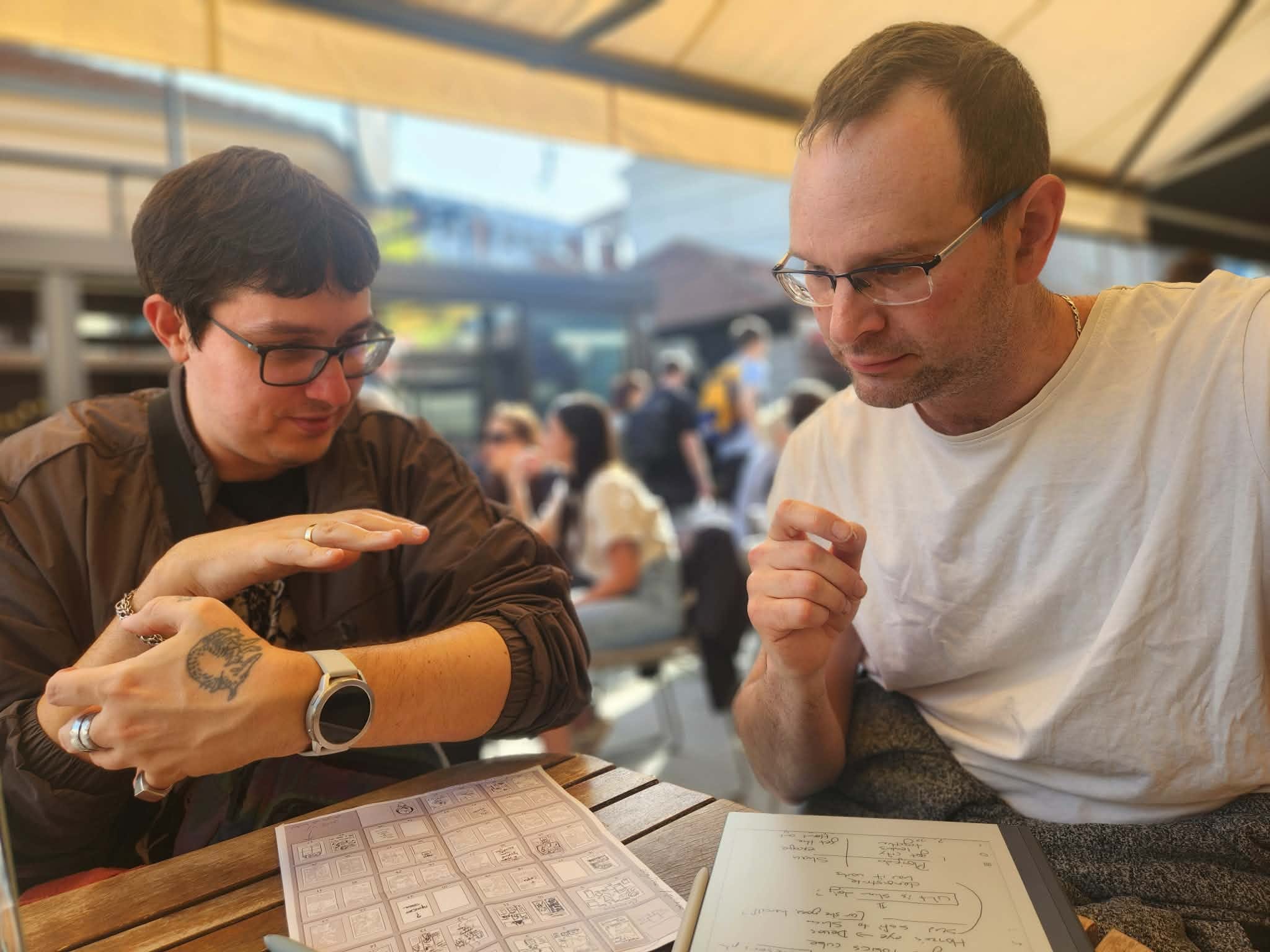
Now, I don’t know what kinds of jobs our backers have, but at the end of the shift, they have a new comic book to read. Sharp Eye issue 1 has finally been shipped out. Thanks to some skara and coffee in Niš, Artyom and I have a script for issue 2, too. But that’s a story for another conversation.
See you next month.
Add glints?
Does the gradient go through the shadow areas?